


About Me
I am a Machine Learning Researcher at OptoScale working on machine vision for real-world production environments.
I received my PhD in Computer Science in 2024 from the University of Oslo, as part of a joint collaboration with UC San Diego, under supervision of Prof. Alexander Cloninger, Dr. Nick Forsch and Dr. Zeljko Kereta. As visiting researcher at UC San Diego I collaborated closely with Prof. Yoav Freund. Prior to this, I also spent time at CERN in the TE-MPE department, working under the supervision of Dr. Daniel Wollman.
Interests
- High-dimensional geometry
- Representation learning
- Neural embeddings
- Vector search
- Applied deep learning
Education
- PhD - Computer Science - 2024University of Oslo (UiO), UC San Diego (UCSD)
- MSc - Applied Physics - 2019Norwegian University of Science and Technology (NTNU)
Publications
Experience
- Machine Learning Engineer

Responsibilities & progression
Jan. 2025 – present
Lead development of automatic feeding system- In charge of system-level planning and architecture
- Worked with YOLO and MoViNet to develop machine vision algorithms
- Developed Object tracking alogrithm for video streams
- Deployed and maintained models and services on production hardware
Jun. 2024 – Dec. 2024
Machine learning infrastructure and efficiency- Improved model efficiency and evaluation pipelines
- Developed and maintained data pipelines
- Strengthened CI/CD for ML workflows
- Visiting Research Scholar

Summary
Supervisor: Prof. Alexander cloninger
As part of my PhD I completed a Research stay at UCSD working with Prof. Alexander Cloninger and Prof. Yoav Freund, the main focus was scalable representation learning for high-dimensional data.
Developed methods for low-dimensional representations that preserve local structure while remaining computationally scalable
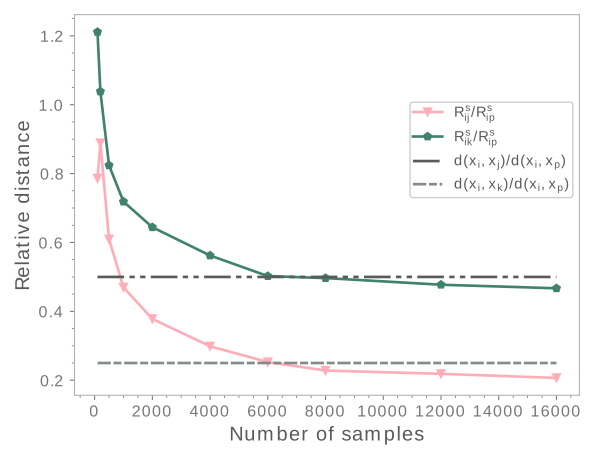
Developed a graph-based embedding approach that scales to large datasets through localization and parallelization, avoiding the quadratic complexity of classical spectral methods
Introduced a hierarchical coordinate system that enables local, zoomed-in analysis of subsets of data without recomputing global embeddings
Demonstrated the method on large-scale datasets, including MNIST and word-embedding corpora, highlighting practical scalability and interpretability
- PhD Candidate in Computer Science


Summary
Supervisors: Prof. Alexander Cloninger, Dr. Zeljko Kereta & Dr. Nickolas Forsch
My PhD focused on developing scalable and reliable learning algorithms for large, high-dimensional datasets, with an emphasis on streaming and parallelization.
Grounded in statistical learning theory, I designed learning methods that reformulate classical algorithms into multi-resolution and boosting-style frameworks, enabling efficient training and inference under realistic memory and compute limits. Key contributions include:
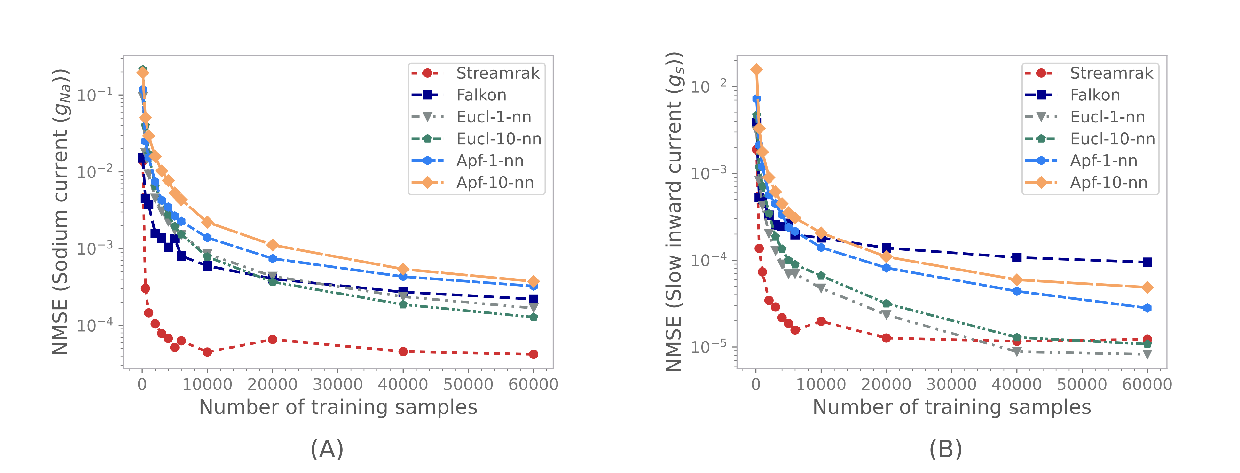
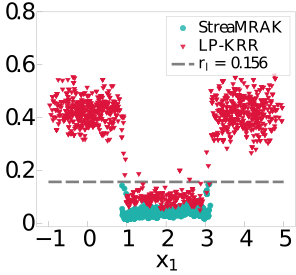
StreaMRAK: A multi-resolution, boosting-based learning framework supporting streaming data and adaptive model complexity
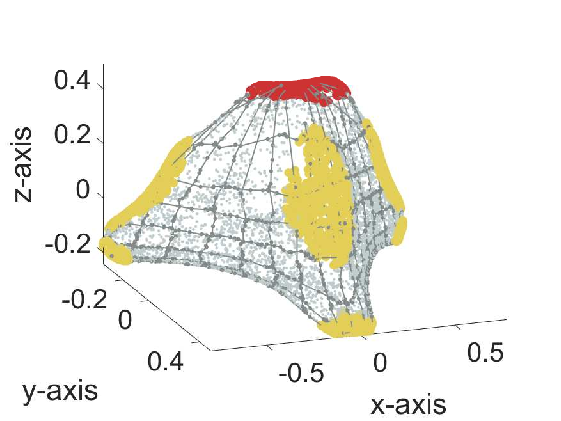
Localized and hierarchical representation learning method for high-dimensional data, compatible with distributed and incremental computation
Applications to large-scale datasets and inverse problems, demonstrating reliable performance with significantly reduced computational cost
Overall, the work focus on theoretical guarantees and practical scalability, with relevance to perception, representation learning, and learning systems used in computer vision and robotics.
- Technical Intern

Summary
As part of the TE-MPE Department (Magnet Protection & Electrical Integrity), I contributed to experimental work supporting the HiLumi upgrade of the LHC.
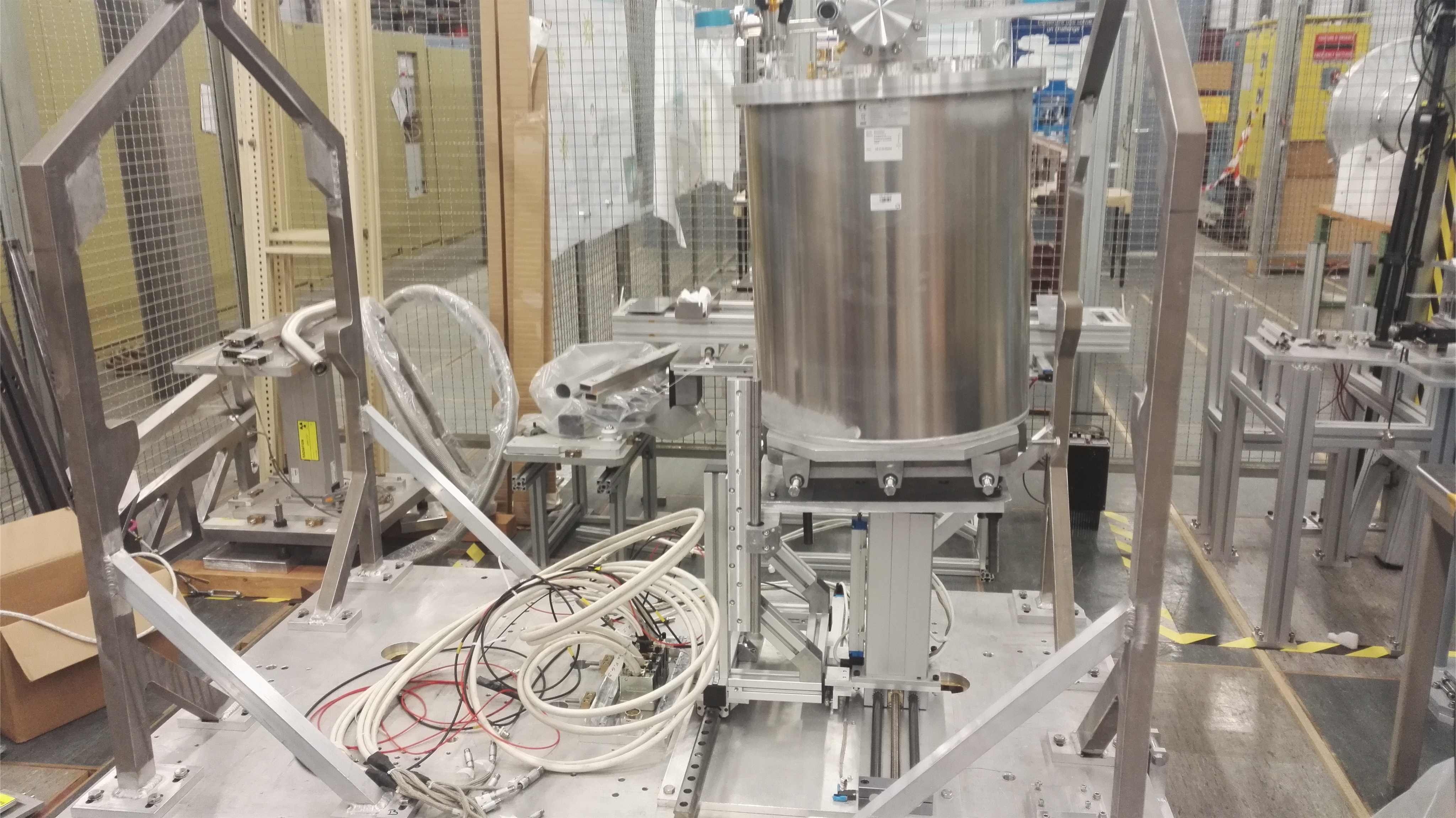
- Designed and built an experiment to study proton-beam effects on superconducting magnets
- Planned the setup and produced CAD designs in collaboration with CERN’s mechanical workshop
- Assembled, executed, and analyzed the experiment, including PXI-based sensor data acquisition
- Technical Intern

Summary
As part of the hyperspectral imaging group at Norsk Elektro Optikk, I worked on improving image quality and signal robustness in their hyperspectral camera systems.
Designed and evaluated low-pass and band-limited filters to improve signal quality
Used Fourier analysis to identify camera and sensor related issues
- MSc in Applied Physics

Thesis — Summary
Developed a gradient-based shape optimisation framework combined with the multimesh finite element method, avoiding costly re-meshing of moving objects.
Derived a novel analytical shape gradient for the Stokes-drag problem using the adjoint approach and Hadamard’s theorem.
Validated the method numerically, demonstrating accurate gradients near extrema and competitive performance on relevant benchmarks.
Master of Science — Summary
Specialization optimization and mathematical modeling
Average grade: A
Subjects
- Optimization
- ODEs & PDEs
- Mathematical Analysis, Linear Algebra, Calculus
- Physics: Optics, Classical Mechanics, Quantum Mechanics, Electromagnetism